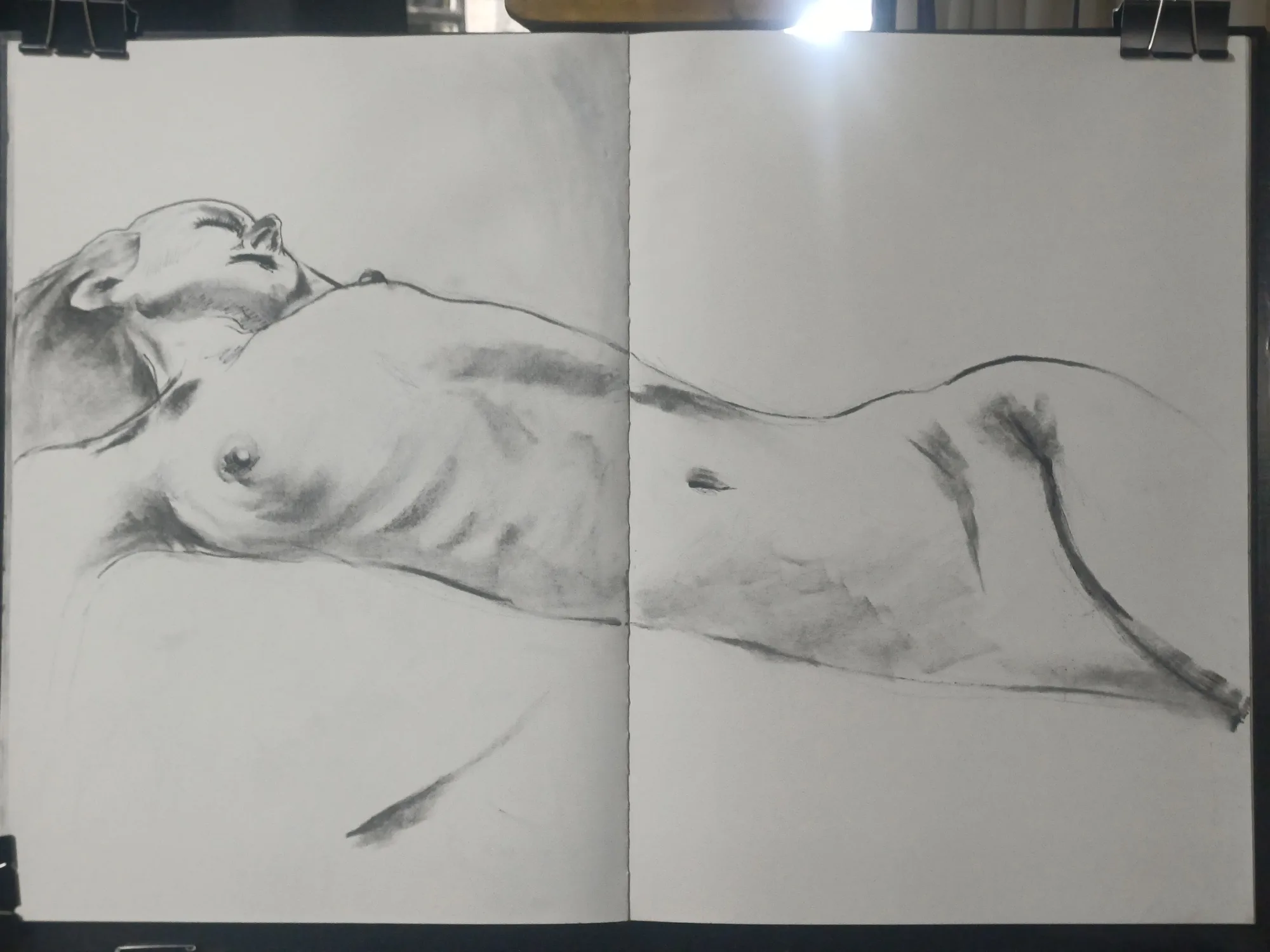
A reclining figure in soft charcoal across an open double-page spread, the body crossing the gutter between pages as naturally as if it weren't there. The head tilts back on the left page — eyes closed, the jaw angled so that the underside of the chin catches light — and the face is given a quiet specificity that the rest of the drawing doesn't attempt. The charcoal there is layered, worked and reworked, building tonal depth through accumulation. Moving across the chest and into the torso, the marks have more direction to them: you can see the strokes that follow the ribcage, the ones that darken beneath the arm, the single confident line that runs along the torso's edge and carries the body across the gutter onto the right page.
On the right page, the drawing changes. The hip is suggested more than stated. The lower body thins to a few soft tonal passages and stretches of bare paper. The charcoal was touched to the surface here but not pressed, not layered. Twenty minutes is enough time to carry tone across a spread if you want to — so this thinning reads as a decision, not a constraint. The attention was given to the head and upper body, and the rest was allowed to exist as suggestion. The drawing has a direction of attention built into it, a gradient from resolved to open, and the figure breathes in the space that opens up where the marks let go.
Seeing this in the same session as the quick ink gestures changes how both pages read. The gestures were about the line — fast, committed, each figure caught in a few strokes. Here the line mostly disappears. The figure is built from tonal fields, from the accumulation of soft marks that describe not edges but the fall of light across surfaces. The shift from line to tone within a single sitting is a real change of mode, and it says something about what becomes possible when the pose gives enough time to stop looking for the figure and start looking at what's already there.
Comments (1)
On the right page, the drawing changes. The hip is suggested more than stated. The lower body thins to a few soft tonal passages and stretches of bare paper. The charcoal was touched to the surface here but not pressed, not layered. Twenty minutes is enough time to carry tone across a spread if you want to — so this thinning reads as a decision, not a constraint. The attention was given to the head and upper body, and the rest was allowed to exist as suggestion. The drawing has a direction of attention built into it, a gradient from resolved to open, and the figure breathes in the space that opens up where the marks let go.
Seeing this in the same session as the quick ink gestures changes how both pages read. The gestures were about the line — fast, committed, each figure caught in a few strokes. Here the line mostly disappears. The figure is built from tonal fields, from the accumulation of soft marks that describe not edges but the fall of light across surfaces. The shift from line to tone within a single sitting is a real change of mode, and it says something about what becomes possible when the pose gives enough time to stop looking for the figure and start looking at what's already there.
Register or sign in to leave a comment.