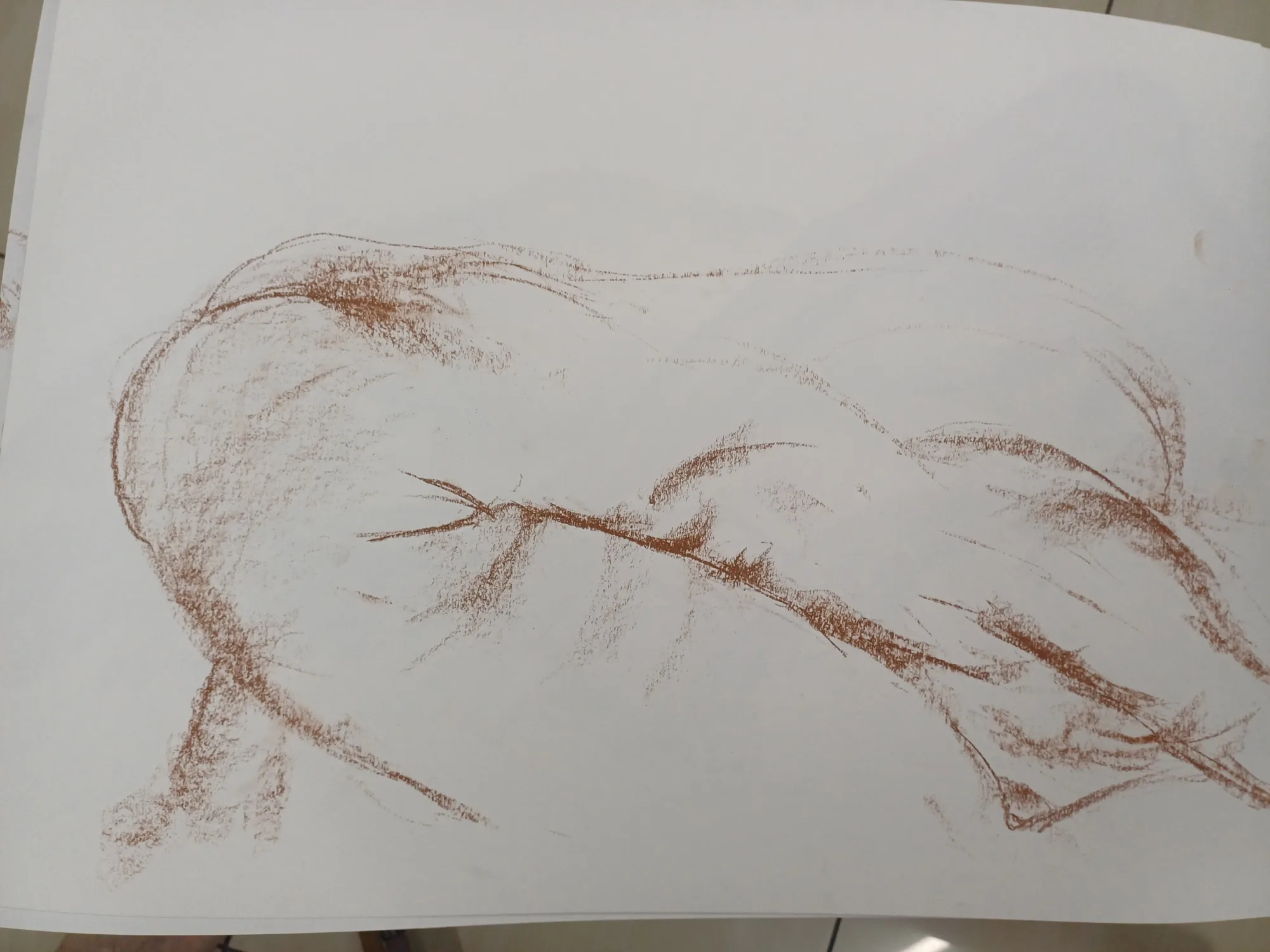
A figure reclining, viewed from behind and the side, the back and hips filling the centre of the sheet. The sanguine is laid down here with broader, more committed gestures than the earlier studies in the series — the marks move fluidly around the body's contours, describing volume through their direction rather than through shading or hatching. A single sweeping stroke follows the line of the back from shoulder to hip, and the body's curve is carried in that one mark. Others layer over it, building weight at the hip and along the lower back where the form turns.
The composition is more filled than the lighter sanguine drawings that precede it, though it isn't crowded. The figure occupies the sheet with a confidence that feels earned — as if the hand had already tested the medium's range in the earlier, lighter studies and now knew how much the chalk could carry. The chalk eases at the limbs, lets the paper breathe at the edges, but where it gathers, the drawing carries.
Across the sanguine series there's a visible loosening that this one sits right in the middle of. The first study was barely there — a few whispered lines. The later ones will become fuller, more resolved. This one has a generosity of line that wraps around the figure rather than outlining it. The line doesn't trace edges; it follows the turn of the form, the way the body occupies space. The curves of the back and hip are drawn with a single impulse each, and the drawing's energy follows — it moves the way the eye moves around a body, not the way a pen traces a silhouette.
Comments (1)
The composition is more filled than the lighter sanguine drawings that precede it, though it isn't crowded. The figure occupies the sheet with a confidence that feels earned — as if the hand had already tested the medium's range in the earlier, lighter studies and now knew how much the chalk could carry. The chalk eases at the limbs, lets the paper breathe at the edges, but where it gathers, the drawing carries.
Across the sanguine series there's a visible loosening that this one sits right in the middle of. The first study was barely there — a few whispered lines. The later ones will become fuller, more resolved. This one has a generosity of line that wraps around the figure rather than outlining it. The line doesn't trace edges; it follows the turn of the form, the way the body occupies space. The curves of the back and hip are drawn with a single impulse each, and the drawing's energy follows — it moves the way the eye moves around a body, not the way a pen traces a silhouette.
Register or sign in to leave a comment.