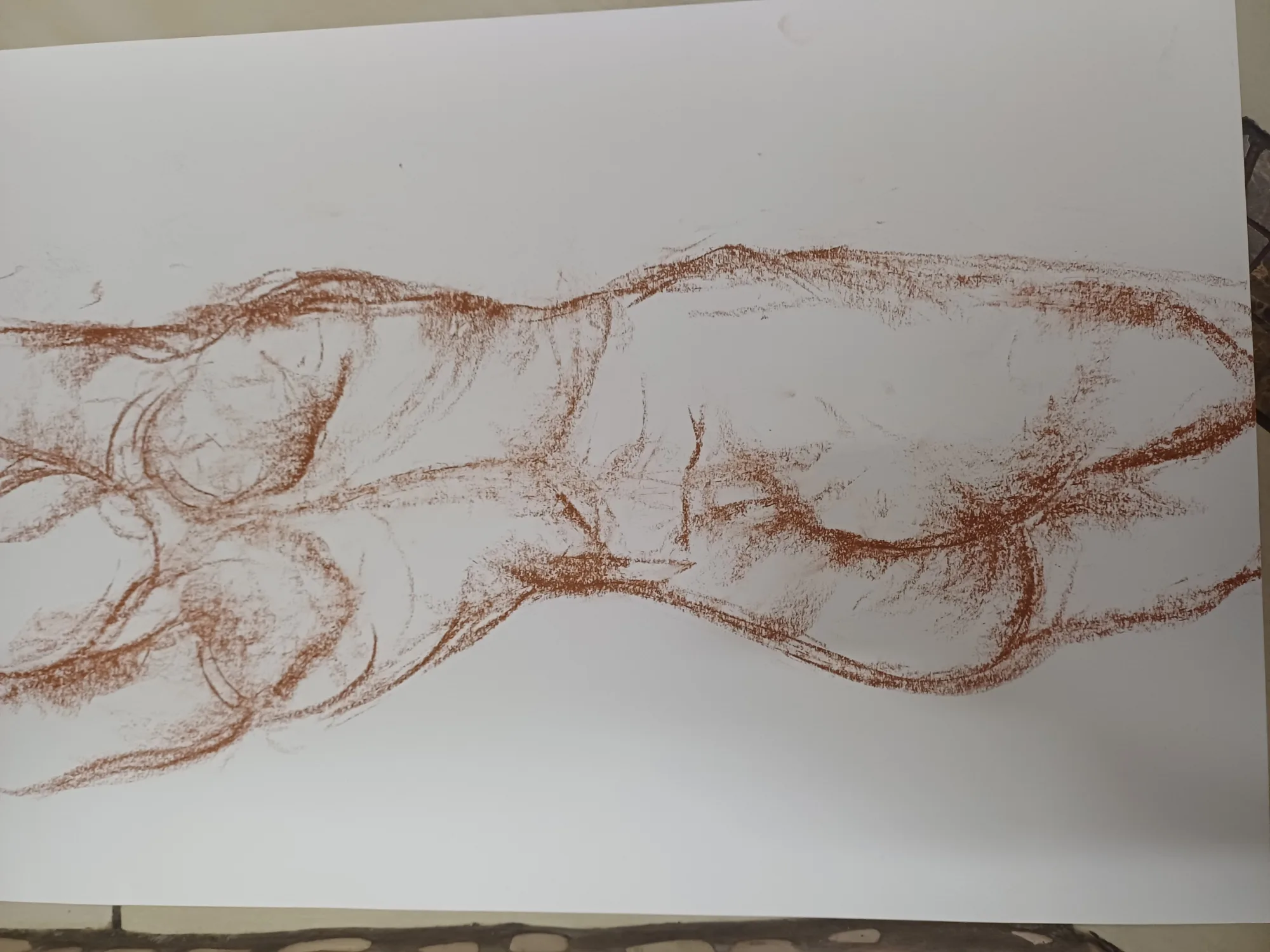
The fullest of the sanguine series — a reclining figure that stretches horizontally across the sheet, the entire body present from head through torso to the limbs. The red chalk moves between heavier pressure at the joints and intersections — the shoulder, the hip, the crease of the waist — and lighter passages where the form opens out along the back and legs. The composition uses the sheet's width to mirror the figure's extension, so the drawing has a horizontal logic that the more compact earlier studies didn't attempt: the body reaches across the paper the way it reached across the surface it was resting on.
There's a completeness here that isn't about detail or finish. The extremities are still open, the face barely indicated, the hands and feet left as suggestions. But the body as a continuous form — its length, its curves, its weight distribution across the horizontal — is fully present in a way that the lighter studies only implied. The sanguine has found its density: not the density of the charcoal work from earlier in the session, but a warmth and substance that comes from the chalk being used with its full range of pressure.
What's more, arriving at this drawing after the earlier sanguine studies, the accumulation across the series becomes visible in a way that wouldn't register if you saw this drawing alone. The first study was breath — barely there, deliberately open. The middle ones built weight, found the medium's range, wrapped line around form. And now this: a figure that occupies its space with an ease that comes from the hand having found its rhythm with the material. There's something resolved here that isn't about resolution in the academic sense. It's about pace. The figure rests; the drawing rests with it.
Comments (1)
There's a completeness here that isn't about detail or finish. The extremities are still open, the face barely indicated, the hands and feet left as suggestions. But the body as a continuous form — its length, its curves, its weight distribution across the horizontal — is fully present in a way that the lighter studies only implied. The sanguine has found its density: not the density of the charcoal work from earlier in the session, but a warmth and substance that comes from the chalk being used with its full range of pressure.
What's more, arriving at this drawing after the earlier sanguine studies, the accumulation across the series becomes visible in a way that wouldn't register if you saw this drawing alone. The first study was breath — barely there, deliberately open. The middle ones built weight, found the medium's range, wrapped line around form. And now this: a figure that occupies its space with an ease that comes from the hand having found its rhythm with the material. There's something resolved here that isn't about resolution in the academic sense. It's about pace. The figure rests; the drawing rests with it.
Register or sign in to leave a comment.